Report · 2026 edition, refreshed 9 September 2026 · INT.02 Build · 8 min read
Brake Pad Market Survey 2026
What 26 tracked pad lines from 14 brands say about compound categories, price tiers and temperature windows, counted from brakepadfinder's registry file.
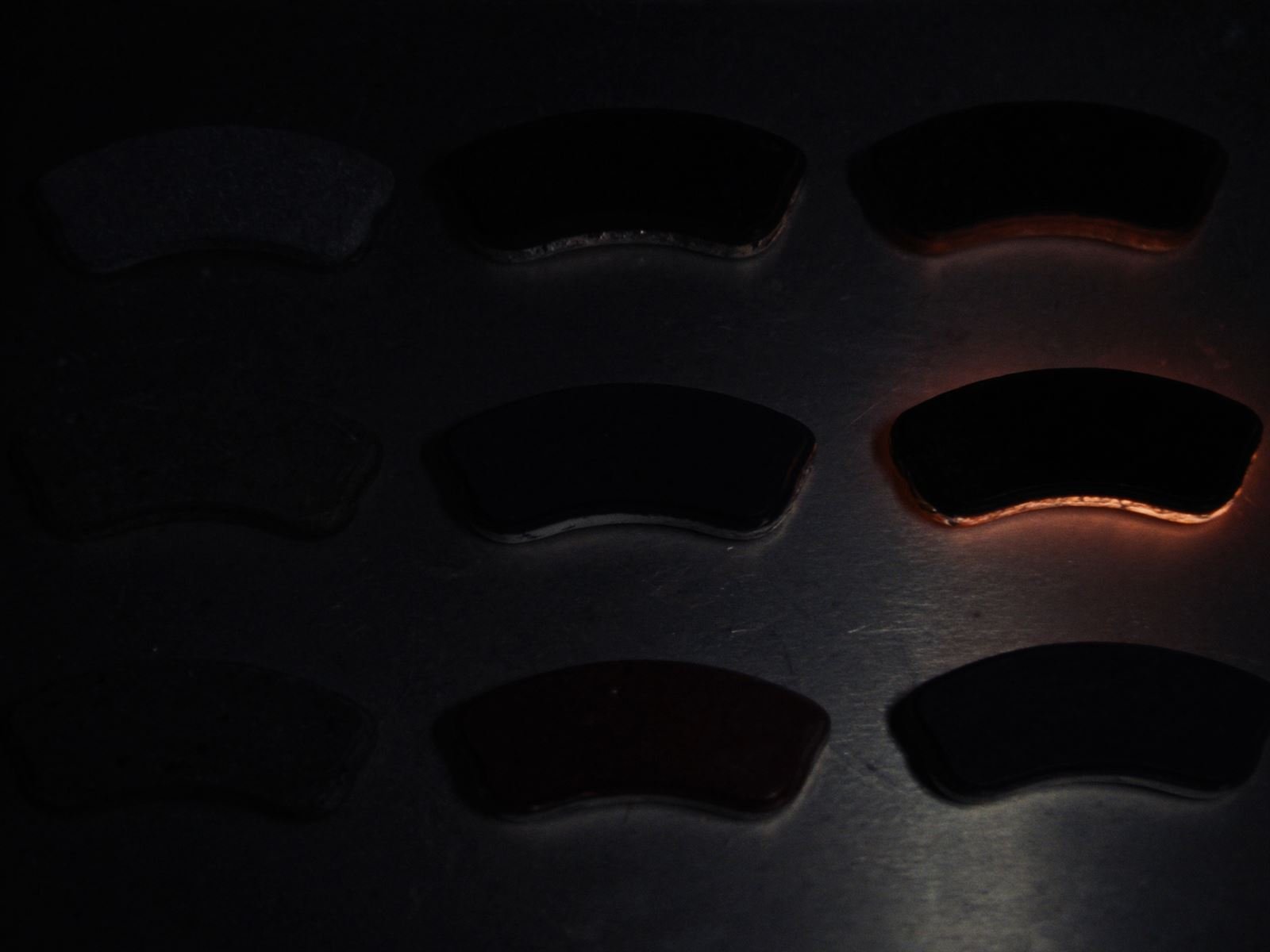
The largest category in the registry is dual-duty, with 7 of 26 lines. This survey counts brakepadfinder's registry, 26 pad lines from 14 brands, into the numbers that matter when you shop: which categories exist, how many lines each holds, how hot they run on average, what they cost and where the gaps are. Every figure on this page was recomputed from the registry file on 9 September 2026 by a script in the hub's repository, and the first edition of 20 July 2026 read the same registry: nothing in it has changed since.
01 — The market in one line
The category split across the 26 lines is comfort 5, sport 6, dual-duty 7, track 6 and tow or heavy 2, which makes dual-duty the largest single category. The centre of the registry is a pad whose average maximum operating temperature is 690°C and which is street-legal on every line in its category (7 of 7).
Compound chemistry tells the same story. The registry names 15 distinct compound families across the 26 pads: ceramics in the comfort lines, ferro-carbon and carbon-metallic families through the middle, sintered race compounds at the top. The middle band is where the temperature ceiling climbs without giving up cold bite, and it is where most of the lines sit.
"The average dual-duty pad in the registry holds about 690°C and stays street-legal."
02 — The temperature ladder
Line the five categories up by average maximum operating temperature and the registry resolves into a ladder. Each step up buys heat capacity and costs civility: dust rises and cold performance falls.
| Category | Lines | Avg max temp | Avg dust (10 = clean) | Streetable |
|---|---|---|---|---|
| Comfort | 5 | ≈ 376°C | 9.0 | 5 of 5 |
| Sport | 6 | ≈ 477°C | 6.0 | 6 of 6 |
| Tow / heavy | 2 | ≈ 515°C | 7.0 | 2 of 2 |
| Dual-duty | 7 | ≈ 690°C | 4.6 | 7 of 7 |
| Track | 6 | ≈ 795°C | 2.8 | 0 of 6 |
Note the gap between sport at about 477°C and dual-duty at about 690°C. That jump of roughly 213 degrees is the real decision point for anyone who drives to the circuit: it is where dust, noise and cold bite start to be traded away for fade resistance.
03 — Price: the missing middle myth
The pricing spread contradicts the usual "cheap or exotic, nothing between" complaint. On the registry's four-tier scale (1 = budget, 4 = premium), tier 1 holds 3 pads, tier 2 holds 10, tier 3 holds 8 and tier 4 holds 5. The centre of gravity is the mid tiers: tiers 2 and 3 together hold 18 of the 26 lines.
Premium track compounds are a small cap on the market, budget lines a small floor. In practice you are mostly choosing within the mid tiers, which means price is a weak differentiator and compound category is a strong one. Inside tier 3 alone, the stated maximum temperatures span 370°C between the coolest and the hottest line.
04 — Two honest gaps
First, EV-ready is thin. Only 5 of the 26 tracked lines are flagged EV-ready in the registry, against 20 of 26 that are streetable. Regenerative braking changes pad duty entirely: long idle periods, low temperatures, sudden hard applications. If you drive a heavy EV hard, your shortlist is short.
Second, track pads score well on life. The registry's average life scores run comfort 7.2, sport 6.3, dual-duty 6.3, track 7.7, and tow 8.0, so track compounds outlast both sport and dual-duty on that measure, and only the two tow lines score higher. The mechanism is simple: a compound built to survive 795°C wears slowly at street temperatures. But an average dust score of 2.8 and weak cold bite make them poor commuters, and 0 of 6 is flagged streetable, so the longevity is a trap unless the car genuinely lives at the circuit.
05 — How to use this
Categories beat brand loyalty. All 14 tracked brands make competent pads; the failures we see are category mismatches, not bad manufacturers. Start by matching a category's temperature window to your real use. Our compound explainer walks through how max temp, dust and bite trade against each other.
The matching itself is what brakepadfinder ↗ does: answer a few questions about the car and how it is used, get the compound categories and specific lines that fit. And if you are recalibrating what braking performance is worth to you, run a few scenarios through the braking distance calculator first. The numbers argue better than any spec sheet.
Method: computed from brakepadfinder's registry file data/pads.js on 2026-09-09 by _build/refresh-brake-pad-report.ps1 in the hub repository; 26 rows; rule: count per category, price tier and flag; averages are plain means of each line's stated maximum temperature and its 0 to 10 dust and life scores. Brands (14): Akebono, Bosch, Carbotech, EBC Brakes, Endless, Ferodo, G-LOC, Hawk, Pagid, PFC, Porterfield, PowerStop, Project Mu, StopTech. The registry itself is brakepadfinder's editorial synthesis of manufacturer specifications and community consensus; its dust, life and temperature values are editorial ratings, not lab tests. First edition 20 July 2026; recomputed 9 September 2026 with no change in any figure.